In The Studio
In the Studio 2: Creating an ensemble
Creating an ensemble takes time and energy. Kneehigh’s rehearsals rely on collaboration and generosity, a shared language, and a common goal.
Ensemble challenge
To embrace a sense of play, set a challenge for your ensemble which doesn’t involve a specific skill or level of experience. You could:
- Make a ‘shrine’ or environment for a specific character or archetype. Perhaps it’s a superhero or villain, a character from a popular book, or a public figure.
- Solve a problem such as how to build the tallest tower possible using only dried spaghetti, balloons and Blu-Tac™.
- Organise a picnic (or design a hypothetical one), with the challenge of having food items beginning with every letter of the alphabet. Kneehigh would eat together after rehearsals in the barns, telling stories, playing games and music: recreating that atmosphere of collaboration and connection is a great way to build the foundations of ensemble.
Ultimately, the focus isn’t the end result of the shrine or the spaghetti tower, or the content of the picnic: instead it’s the process of thinking playfully and creatively, without censorship and without needing to achieve perfection. It’s that spirit, which embraces uncertainty and chaos, that you’re trying to emulate in the rehearsal room!
In the Studio 3: Build a heightened state of alertness
Here are a few starting points for creating ensemble:
Build a heightened state of alertness
With your whole group, all of whom should be hungry to give and hungry to receive, move around the space, eyes wide and alive. One person clicks their fingers purposefully and intentionally at someone. They should make eye contact and use clear, purposeful movement to ‘pass’ that click physically as well as through the sound it makes. Pass the click from one person to another. (One person clicks with intent at someone else. That person then passes it on to someone else, and so on. Make sure you receive the click as physically as it is given. ‘Catch it’ between your hands, or use your eye level as if you’re following it in the air.
If the passing of the click becomes casual, up the stakes by replacing the click with a physical item: a stick, a potato, a boot, an egg (!)
Add more layers to this game. If you’re using one stick to pass around, you could then add multiple sticks. Everyone should always know where the stick (or the click, or the object) is: that’s the focus.
In the Studio 4: Working with canes
Companies such as Kneehigh and Complicité often use bamboo canes (like those found in garden centres) during rehearsal and Research & Development (R&D) - working in pairs, balancing the two ends of the canes in the palm of hands, between finger tips. There are a lot of variations to working with canes or sticks. They bring a sense of focus and awareness, and a strong sense of working with your fellow performers. Try these exercises to enhance focus, explore movement and levels, and develop spatial awareness.
Each pair has one cane between them. Place the ends of the cane against the palm of one hand each (one person on each end of the cane) and explore the pressure that is needed to keep the cane aloft. Once that has been established, the pair should then start to slowly move around the room, keeping the cane aloft, but moving it in various directions. Care should be taken to maneuver around other pairs who are working in the same space, and this can create interesting interactions as people move under or over others.
As confidence grows, suspend the cane using one fingertip each, rather than the palm of the hand. This requires greater skill and focus. Challenge participants to sustain eye contact with each other as much as possible as they continue to move around the room, keeping the cane moving and suspended.
Create more opportunities for the pairs to interact with each other. Perhaps they can create a sense of a wave, a shoal of fish, a train - whatever comes to mind!
In the Studio 5: States of tension
In a group of about 5, set the following scenario:
5 people are all painting a wall several storeys up in a block of flats - encourage individual painting styles and vocal sound effects.
There’s a threat (individuals decide what the threat is) and decide in which direction it’s coming from. The threat is represented by a clap which the task leader will deliver.
- 1st clap: No reaction, painting action continues in individual rhythms. The audience/viewer becomes aware of something the protagonists aren’t.
- 2nd clap: Continue the painting action but acknowledge the threat.
- 3rd clap: Stop the action, acknowledge the threat, tune into the group, eventually find the rhythm of the action…phew...relief!
- 4th clap: Immediate stop, hiatus, group find the moment to all return to action but at double speed
- 5th clap: Freeze: maybe just eyes flick
- 6th clap: The THREAT is upon you !!
Practise this exercise then play with it. Escape from the block of flats, down the emergency stairs - repeat the claps - run down the street - repeat the claps.
Try the exercise in different scenarios/scenes. You might edit some of the sequence and polish it.
In the Studio 6: Combining different performance elements (design, puppetry, music, improvisation)
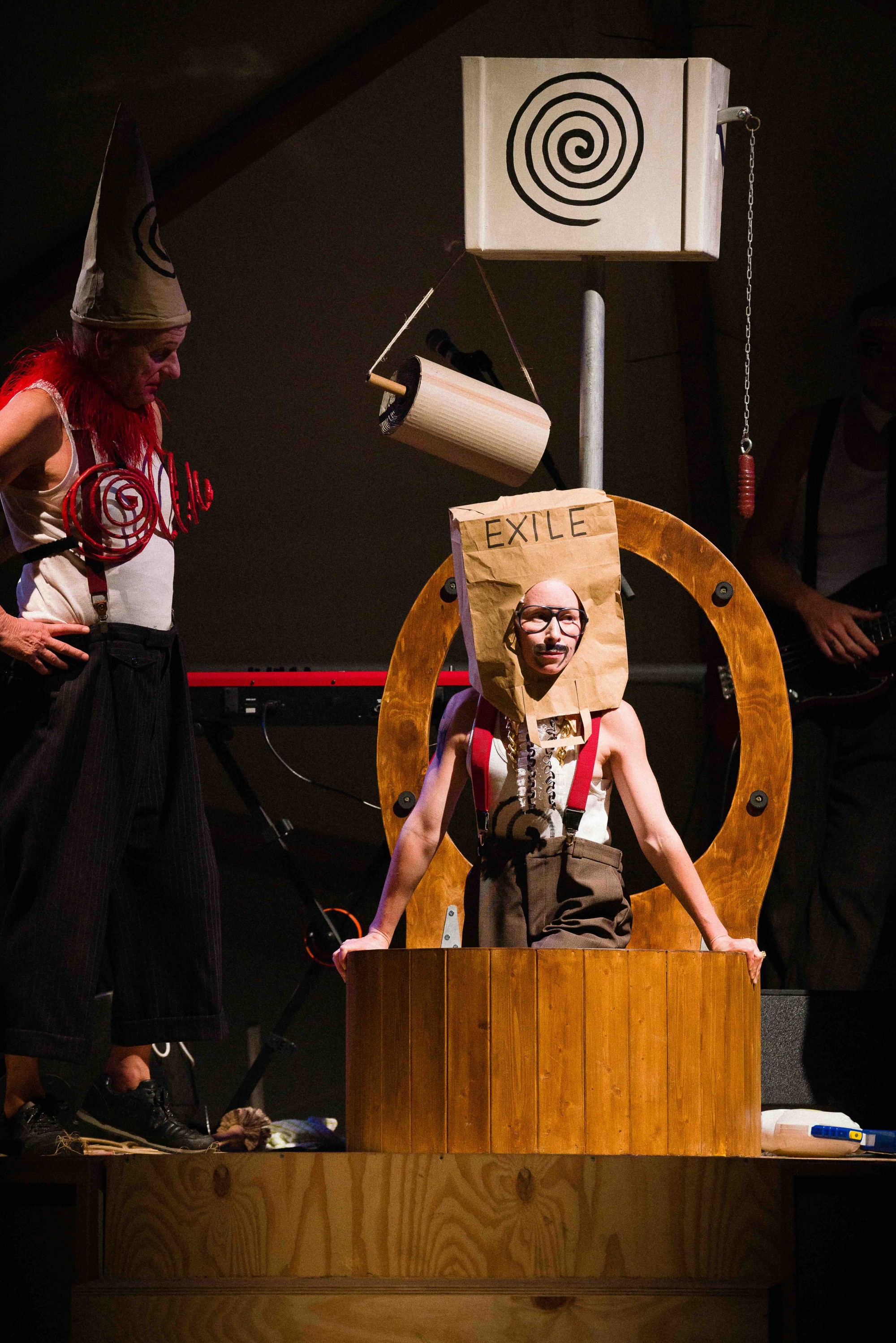
Designers are involved in the process of making a show from the very beginning. Staging choices and design ideas are completely integrated - rather than an add-on. If you’re working in the style of Kneehigh, a designer is a key decision-maker from the start!
When you’re working with a script that already exists (rather than devising your own), think about how you can introduce playfulness into your rehearsal and your creative decisions.
- Playing with costume: Dress each other up. Don’t discuss it or overthink it!
- Building a playground: Take the idea that Bill Mitchell would ‘create a playground’ and create a set for your piece that allows you and your characters to play
- Creating a sense of place: Think about music and lighting, as well as set. Refer back to the ideas about archetype that are explored elsewhere in this pack.
- Multi-roling: Play as many characters as you can, and see what connections there are between them! You might not play all of those characters in your actual performance, but see what happens when you try to portray opposing/similar characters!
- Use of puppetry: Animate anything - it doesn’t need to be your traditional idea of a puppet! Find the naughtiness, the archetype or the function of a puppet in how they can swell your cast or represent an idea or theme.
- Live musicians: Each of you can bring a song that makes you want to dance, or makes you cry, or laugh. Identify a song that might be your character’s favourite, or one that sets the mood or period of your play. Sing live, play instruments or, even better, invent them!You might also consider creating a playlist for the script: or simply play some music in the background and see what happens!
In the Studio 7: Making spontaneous offers
Mike says:
“Our rehearsals will include working on physical articulation, holding a moment, creating ‘full stops’ and points of focus for the audience. The following exercise then produces ideas that move the devised work on. I like to do this exercise in a space that’s been marked out on the floor (i.e. by masking tape) so that there’s something tangible, a space to be charged and the presence of perimeter for showing when you’re on stage and when you’re off!
Standing in a circle, mark three beats (not necessarily saying them out loud - the group can feel it). On the 4th beat, everyone jumps into the circle and makes a physical offer: a pose or a position. Hold that position for 3 more beats, and whilst doing so, tune into and adjust to the other people in the circle.
In the space of 3 more beats, everyone find a common focus: a point or person to look at. It might initially take more than 3 beats, depending on the experience and cohesion of the group.
Everyone in this circle is actively involved in this ‘moment’ that has been created. What do they see? What might be happening? Who might each person be? At this point, you might want to have some people observing this circle to make suggestions, or you could take a photograph to record that moment.
This offers the opportunity to then harvest all the ideas - the participants can come out of their positions. I am wary of encouraging discussion so use big sheets of paper and write when possible, single words. Once harvested, look to select and edit these ideas. I find grouping ideas in families or categories effective.
Once the selecting and editing has happened, your stepping stones are revealed which can then be developed and crafted into expanding the scene(s).
It’s important to make decisions in devised work to counter the risk of endless possibilities going nowhere. Make decisions, initially accept them and find ways of making those ideas better. You can always decide later to cut them!”
In the Studio 8: Starting with the story
Storytelling
Choosing the story is just the first step. Once the decision has been made, you can start to play!
Return to the story, and retell it to each other. Tell it from different points of view, relate it to your own experience. If you’re retelling the story of Red Riding Hood, for example, link it to examples of when you’ve gone against good advice. Scribble thoughts on large pieces of paper with a felt tip or crayon (neatness is not your priority!) but don’t spend too much time sitting down.
Instead, improvise scenes from the basic story. Where can you subvert the characters, and introduce a more playful approach to the narrative? Which characters need more of a voice than the story usually allows? What happens if you allow them to lead the scene?
In the Studio 9: Bag sculpture
Take the contents of your own bag and make a sculpture. You’re working on your own, this whole space is becoming an art gallery. Take your time. Play music in the background.
Make decisions, work spatially, look at your sculpture from different angles.
Is there anything extraneous? Get rid of it.
Give your sculpture a title.
All visit the ‘art gallery’, invite the artist to talk about their work and the title. Imagine the sculpture has the clues to a life - who would this person be? What would the chapter heading be if it were part of a book? Encourage chapter headings. Again harvest and collect: be detectives. There is a story that exists, and these are the clues. Find the story.
In the Studio 10: Exploring archetypes and archetypal symbols
Task
You’ll need two six-sided dice. Firstly, each person rolls both dice to be allocated a character archetype. For example, if you roll an 8 you are a magician. If you already have a character with that number, roll again to avoid doubling up characters.
Then, one person in the group rolls ONE die, to select an archetypal plot. Rolling a 5, for example, would create a revenge-based plot.
Improvise that plot line - perhaps select some appropriate music on a streaming platform such as Spotify to accompany your improvisation to create some atmosphere!
During this improvisation, you are not aiming for a perfect story or performance. Instead, you are looking for moments of wonder where there are opportunities for magical storytelling. You’re likely to find those moments where the archetypes are in opposition with each other, perhaps in a struggle for power or status.
As you explore the story, take care to create the setting for your audience through your physicality. If it’s a journey you’re creating, make the physical struggle real! In fact, you could even take your audience with you on the quest!
Once you’ve achieved as much as possible from the improvisation, choose moments to expand and develop. You might like to give your character a theme song that suits them, create a physical sequence in which they show off their strength for example. The key word in this task is PLAY.
Added design challenge: Archetypal symbols
Archetypes also include symbols. For example, Spring can be an image of rebirth and regeneration. Water often represents redemption or rebirth. If you’re working with designers, ask them to watch your improvisation and provide some rough sketches of symbols that might support the narrative.
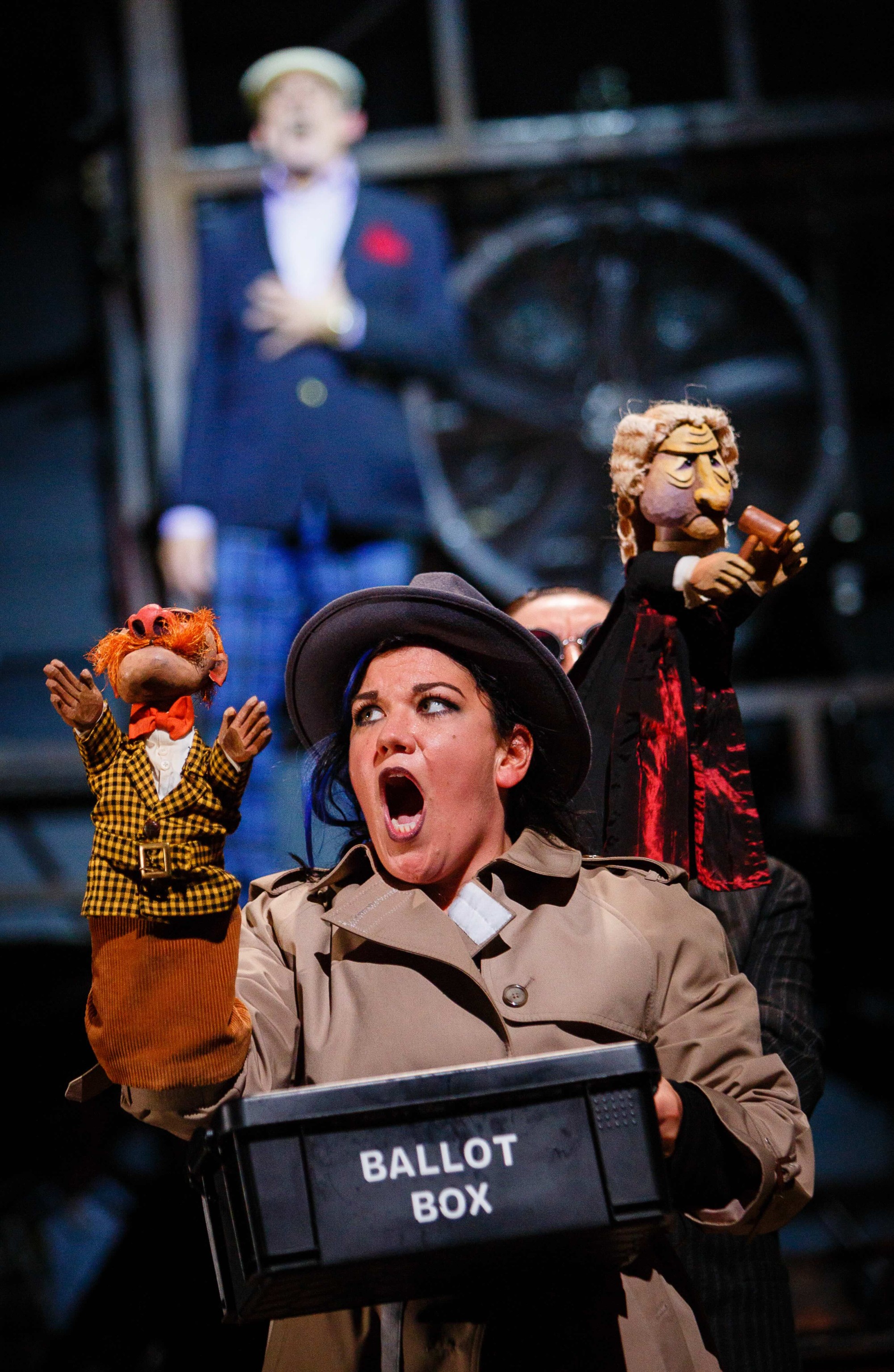
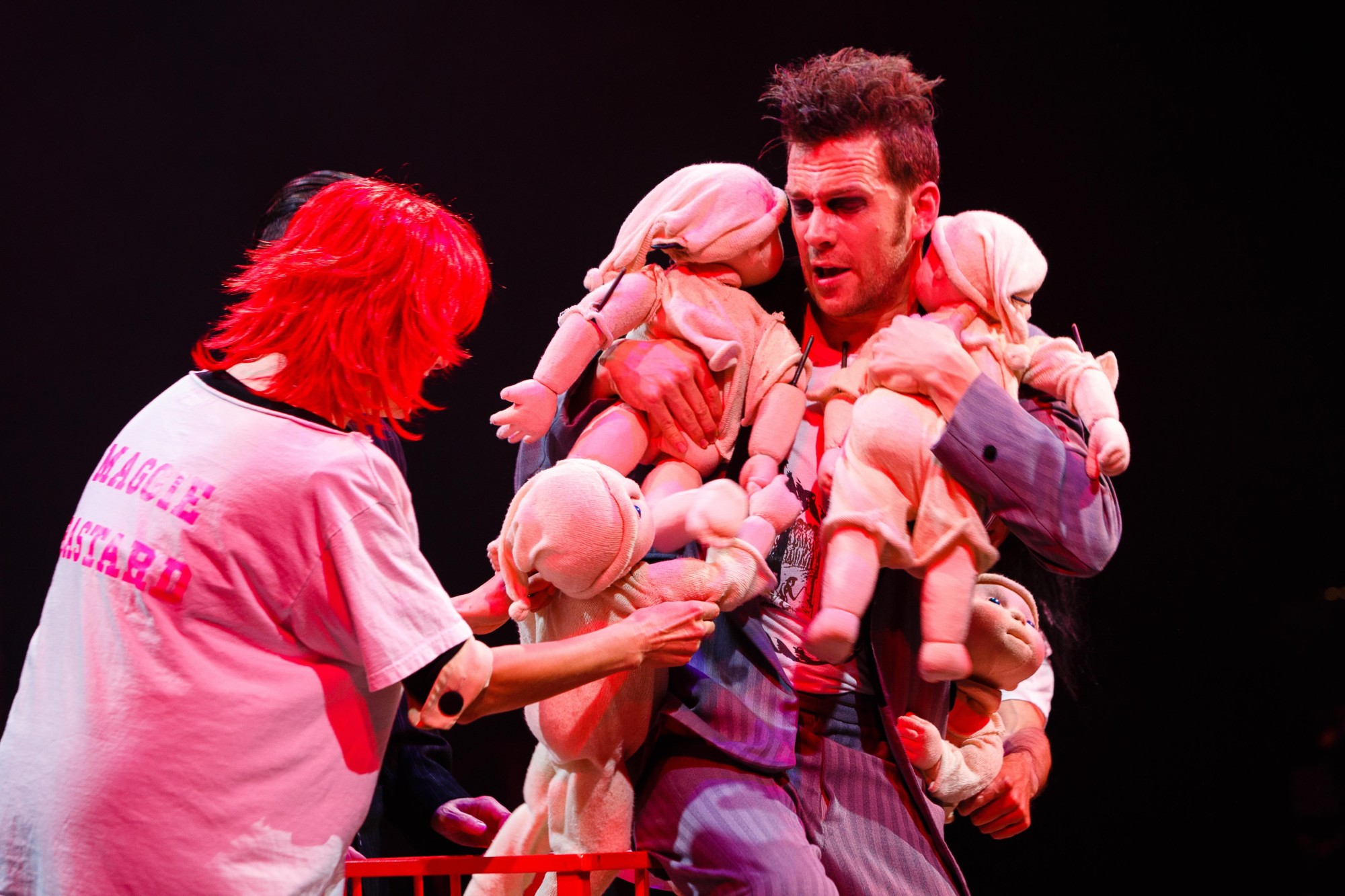
Puppets can communicate archetypes very effectively. In Dead Dog in a Suitcase, puppets were used to represent a range of themes and characters:
The dog = innocence
Babies = consequences of careless love
Glove puppets = political parody, politicians as being puppets of other masters
Giant dog = destruction.
1 / 3