In The Studio

In the Studio 11: Stories and Images

Anna Maria Murphy wrote a number of plays with and for Kneehigh. In this video by Brett Harvey The Secret Writer, you can hear about some of her inspiration and methods.

Anna provides a number of starting points for writing in the tasks below:

Stories and Images

  • What story are you burning to tell? 
  • Make a list of subjects and stories that have been on your mind for a while.
  • Then make a list of images (Think filmically) that go with those ideas. 
  • Invent titles. Sometimes I don’t know what the full story is, but still invent a title, e.g: ‘Roger Salmon, A Cornish Detective’. That title gave me a starting point for the disparate stories that I wanted to tell, and I then knew that the structure would be Roger Salmon investigating them.
In the Studio 12: Making a scrapbook

Make a scrap book of images, words, music, colours,  scrawled ideas around your spark of an idea/theme. They are great ways to start a process and then share visually with others. 

You could make individual ones, or as a group of collaborators, make a few pages each and make one great almighty scrapbook!


In the Studio 13: The Miss Hibbs method

Anna Maria Murphy suggests more ideas to help you, inspired by Cornwall teacher, Miss Hibbs, whose technique of breaking down stories to basic headlines underpins much of the devising process for Kneehigh’s work:

Miss Hibbs used to break stories down with her young people into a number of chapter headings or headlines. She would encourage you to tell the story in as few headlines as possible i.e 5 or 7 or maybe 9. (she would like it to be an odd number!) Then Miss Hibbs would get her class to choose one headline or story point and just write about that. It is an excellent way of understanding structure and keeping things simple and energised.

Practise Task

Take a well known fairy or folk tale, e.g.: Red Riding Hood or The Three Little Pigs. In a group decide among you the main points of the story, then tell the whole story is 5 tabloid headlines.

These are your “scenes” if you like. Once you have these, you can play around with the order. In Tristan and Yseult we started the play at the end, went full circle, then back to the end again. Be playful with your structure and storytelling. 

Then write the themes of the story, as many as you can: i.e. adventure, hunger, danger etc. However many you have generated, then reduce them to just three. Write these three in large letters somewhere, as they will be the beating heart of your story, and keep returning to them.  From this , make your own storyboard, both useful for film, theatre, dance, design, music etc.

We would do this at the start of any Kneehigh creative process. 


In the Studio 14: Finding the Wonder: Keepy Uppy

Place one A3-sized piece of paper at one end of the rehearsal space. This is your ‘goal’. Next, take another piece of A3 paper and scrunch it into a ball. Divide your ensemble into groups. This could be anything from pairs upwards but the smaller the group, the harder the task!

One by one, each team stands at the other end of the room to the goal.  A referee throws the paperball upwards, and between them, the team must keep the ball airborne until it hits the goal. Each player can only touch the ball once before someone else must take their turn, using similar moves to volleyball. If the ball lands on the floor at any other place than the goal, they must begin again from the start.

The teams who are not in active play should watch the game unfold, looking for moments of wonder - those moments that inspire awe and excitement in an audience. They can be moments of tension, moments of frustration and humour, interesting groupings as people work out the best tactic for the game and even ideas for characters. It’s also a great source of ideas for choreography for chase sequences, escapees or lovers running to or from something!


In the Studio 15: The Game With No Rules

Mark out a playing area. Divide into two teams, with everyone else acting as the spectators. Imagine this is the final of a huge championship - the stakes couldn't be higher!

Each team has a set of objects to play with. Use whatever is available: chairs, beanbags, perhaps even a wildcard object like a potato.

Your challenge is to invent a game as you play it. There are no spoken rules. Instead, communicate through your actions. As the game unfolds, the rules will gradually emerge.

Keep playing until the spectators begin to understand the game. They'll let you know when someone makes a brilliant move, breaks an unspoken rule, or does something unexpected.

Eventually, discover the move that wins the game. You'll know the exercise is over when everyone agrees that someone has won!


In the Studio 16: What Are You Doing?

Ask your ensemble to stand in a circle. One person in the middle starts an action. The next person comes in and asks “what are you doing?” The original player can answer anything they like as long as it’s not what they are actually doing. The person coming in then does that action and the first person leaves… repeat.

Spectators actively watch improvisations, and ask “what did we like?”

Write down actions/scenes on big pieces of paper, randomly combine scenes, identify what’s missing, find the missing scene, find the ending. Generate these scenes quickly: see Keith Johnstone’s ‘Scenes in a Minute’, ‘Gifts’ and ‘Hat Game’ in his book Impro for Storytellers. 

Write down scenes on individual postcards, shuffle the pack, look at the card and link scenes together. Find ways to incorporate scenes and create an ending.


In the Studio 17: Games and tasks for when you get stuck!

Many of Kneehigh’s most imaginative and theatrical moments have stemmed from task-based activities during rehearsals. You could, for example, set one or more of the following tasks:

  • Create a costume for a character using random clothing in a dressing up box. Two people select and dress a third person who becomes the character
  • Write a haiku to describe a character’s thoughts or emotions
  • Improvise a journey through a landscape, using mime
  • Invent a new game that can be played in your specific rehearsal space
  • Go outside or to the props store or cupboard and find five things that represent the place in which your story is set or where the character inhabits.Bring them back and tell the story of each item.
  • Choose an unfamiliar piece of music and dance to it
  • Sketch a picture as if you were a character in your story

The outcome of each of these tasks is not fixed. Instead they are designed to free up the imagination. You may not use these ideas in your final piece, you might choose to discard them now or later,  but their influence will be there somewhere!


In the Studio 18: Music to encourage dance

Use music, create playlists and encourage dance!

For those reticent to dance… hoodwink them eg: everyone have a paper plate, be a waiter, keep holding the plate as if it has food on it, can you turn it around your own arm, can you have two plates? Use different levels, incorporate music. Have a skip, try mirroring,specific dance moves i.e a sand dance (show them Wilson Keppel and Betty!) Falling off a log, hip hop, skating, ballet, northern soul, Bollywood, jitterbug, floss, capoeira etc !

In a circle, everyone has a satsuma or a potato. Play the music you want to dance to. Where’s the point to start the moves? Throw the satsuma from  the right to left hand and back again, add other moves i.e under each leg, spin around then pass to the person on your left..keep going to the music.. a dance routine emerges.


In the Studio 19: Inside Outside

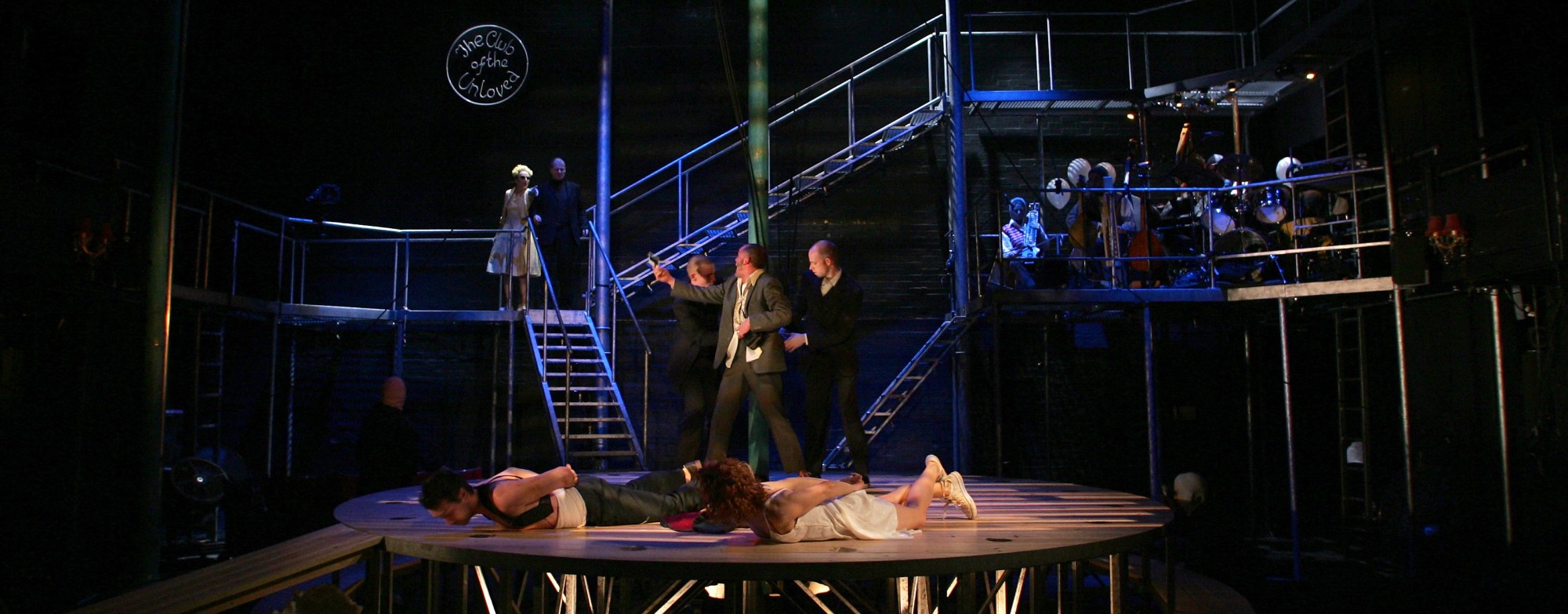
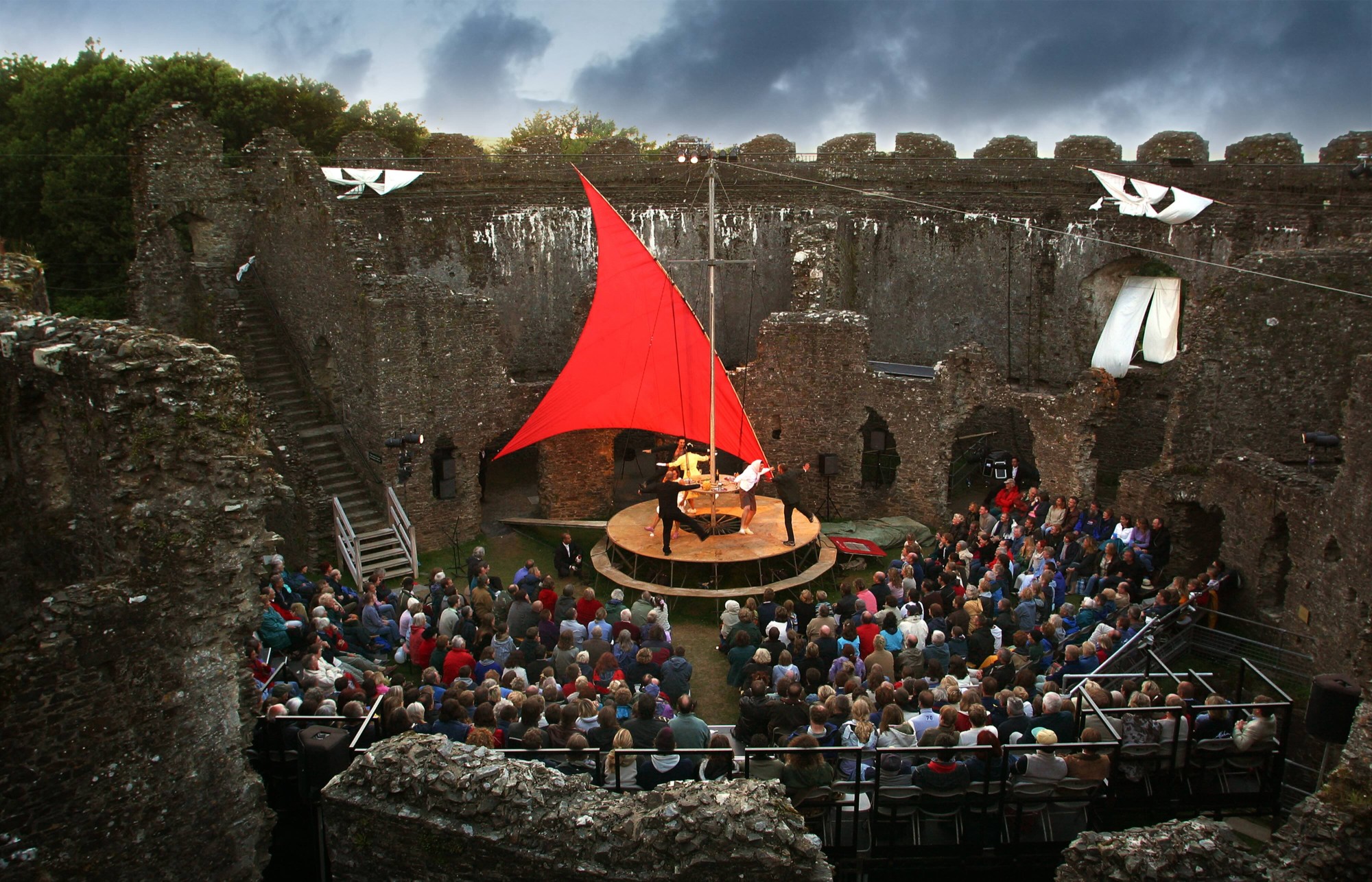
Watch this video of Bill Mitchell talking about the differences between designing and directing for outdoor and indoor spaces. Notice the way in which the company adapted Tristan and Yseult design for the Cottesloe Theatre (now the Dorfman, at the National Theatre) after their success performing the play outside. 

It might be tempting to sit down and design a set before trying out ideas as the performers start to put the story on its feet. However, for Kneehigh, the design process is integral from the beginning of rehearsals. As you rehearse, try out ideas and have items of set around you to play and experiment with. 

Wild Bride
We would try not to rehearse indoors too much, because if you stay indoors, you start talking your ideas out rather than doing them. Try and make the work on your feet.

As Sue Hill states, it’s important that you take an active approach to creating a piece of theatre rather than spending too much time chatting!

By taking your rehearsals to a different rehearsal space (either indoor or outdoors), you’ll quickly identify what items of the set are vital, which can be temporary and which ones need to be on stage for the entire performance. Ensure that the lighting design is also taken into consideration when designing the set. Does your set allow for puppetry? Where will the performers be when they’re not acting? Quite often, all of the Kneehigh performers would remain on stage for the entire performance and so you’ll need somewhere for them to be that doesn’t pull focus away from the action.


In the Studio 20: Costume

Task

Costume ideas and decisions can come from playful tasks and activities.  Find a range of different clothing items. Your challenge is to create a character using those clothes, BUT at least two of those items must be worn differently to the way in which they were originally designed to be worn. What happens when you wear trousers as sleeves, or you put your legs through the sleeves of a jumper?


2 / 3